Eschmeyer’s Scorpionfish: Complete Marine Care Guide & Tank Specs
1. Biological Profile & Species Overview of Eschmeyer’s Scorpionfish
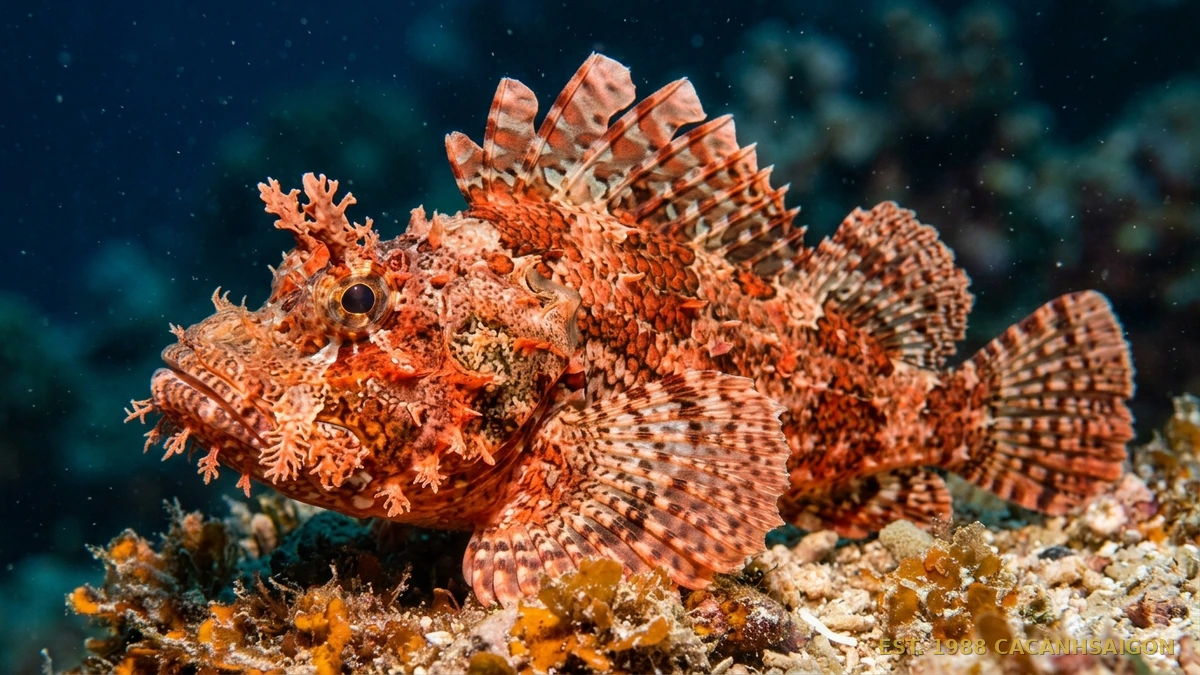
Belonging to the family **Scorpaenidae**, Eschmeyer’s Scorpionfish is naturally distributed throughout the marine habitats of Ấn Độ Dương – Tây Thái Bình Dương. In mature specimens, it reaches an average adult size of **19.0 cm**, necessitating a display aquarium of at least **250 Liters**. Distinguishing biological morphology: Toàn thân phẳng dẹt màu vàng chanh hoặc cam đất với vây lưng liền mạch không xẻ thùy, dáng đi như chèo lái dưới đáy rạn.
Reef tank compatibility is rated as **Reef Safe With Caution**. Care difficulty is designated as **Chuyên gia (Quý hiếm tuyệt đỉnh)**, accompanied by an innate behavioral temperament: **Bình tĩnh, ngụy trang**. Ensuring robust vitality requires high dissolved oxygen concentrations, disciplined nutrient control, and mature biological filtration.
Quick Facts & Care Profile: Eschmeyer’s Scorpionfish (Rhinopias eschmeyeri)
.sgcc-table-wrap .sgcc-facts th,
.sgcc-table-wrap table th {
background: #06253a !important;
background-color: #06253a !important;
color: #ffffff !important;
font-weight: 700 !important;
}
.sgcc-table-wrap .sgcc-facts td,
.sgcc-table-wrap table td {
color: #102330 !important;
}
| Common Name | Eschmeyer’s Scorpionfish |
|---|---|
| Scientific Name | Rhinopias eschmeyeri |
| English Name | Eschmeyer’s Scorpionfish |
| Family | Scorpaenidae |
| Natural Origin | Indian Ocean – Western Pacific Ocean |
| Adult Size | Approx. 19 cm (7.5 inches) |
| Ideal pH | 8.1 – 8.4 (Standard Marine Reef Alkalinity) |
| Water Temperature | 24 – 26 °C / 75 – 79 °F (Chiller Stabilized) |
| Specific Gravity & Salinity | 1.023 – 1.025 SG | 32 – 35 ppt |
| Minimum Tank Size | 250 Liters (~66 US Gallons) |
| Dietary Protocol | Ăn tôm tép sống, mysis shrimp lớn |
| Reef Compatibility | Reef Safe With Caution |
| Temperament & Care | Bình tĩnh, ngụy trang • Chuyên gia (Quý hiếm tuyệt đỉnh) • Active reef dweller |
2. Water Quality Standards & Marine Chemistry Benchmark
Reef inhabitants require rigorous replication of natural seawater chemistry. Maintain thermal stability at 24°C to 26°C (75°F – 79°F), Specific Gravity (Salinity) within 1.023 to 1.025 SG (32 – 35 ppt), and pH buffered precisely between 8.1 and 8.4.
Alkalinity must be stabilized at 8 – 11 dKH, with Calcium at 400 – 450 ppm and Magnesium maintained at 1250 – 1350 ppm. Ammonia (NH3) and Nitrite (NO2) must measure an absolute 0 ppm at all times; Nitrate (NO3) should be kept under 10 ppm, and Phosphate (PO4) below 0.05 ppm utilizing high-efficiency fractionators and UV sterilization.
3. Aquascaping Architecture, Filtration & Hydrodynamic Flow
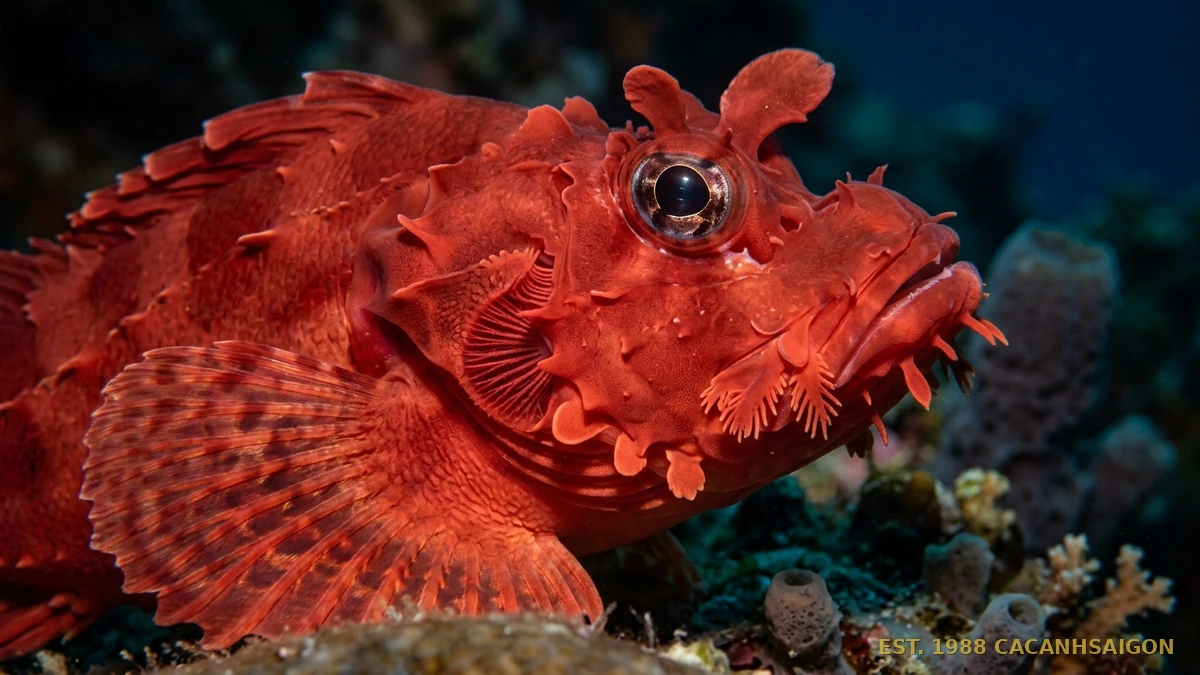
A minimum display volume of **250 Liters** is mandatory for Eschmeyer’s Scorpionfish. The aquascape should incorporate porous coralline live rock arranged into natural archways, overhangs, and secure crevices that provide resting shelters during nocturnal cycles. Generous open swimming corridors must remain unhindered across the front viewing pane.
Filtration architecture should incorporate an oversized protein skimmer, dedicated biological media, and full-spectrum LED lighting (15000K – 20000K actinic blend). Wavemakers configured in alternating gyre pulses ensure effective detritus suspension.
4. Daily Nutritional Protocol, Feeding Regimen & Tankmate Compatibility
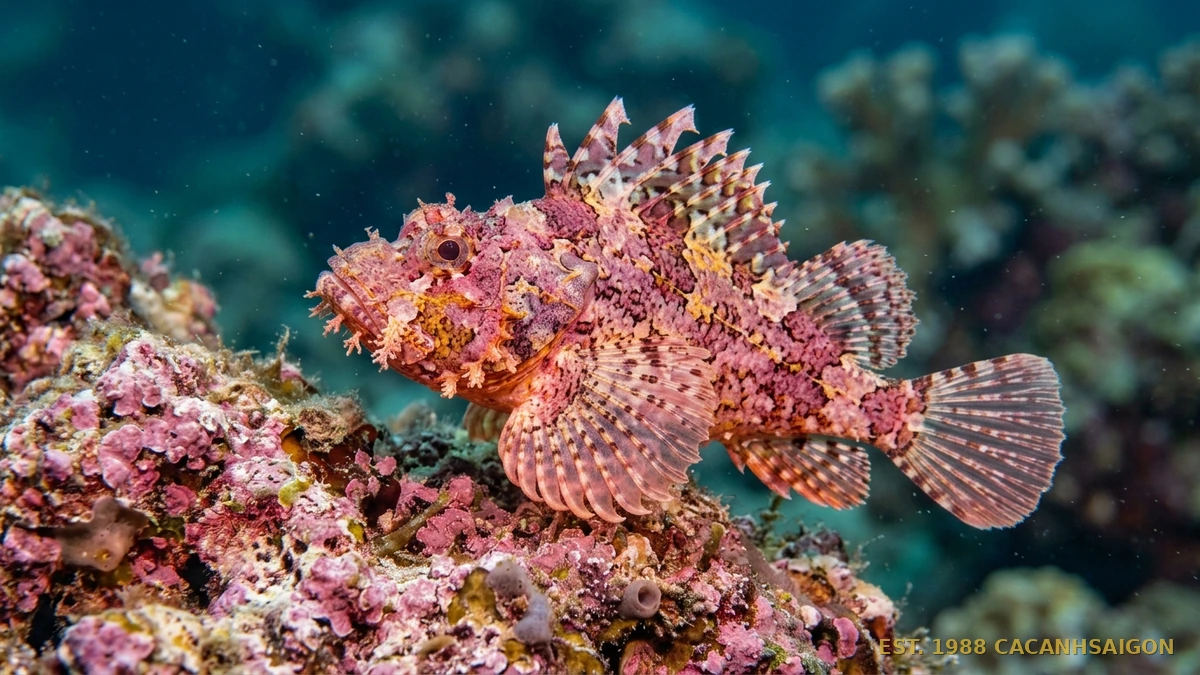
The dietary classification of Eschmeyer’s Scorpionfish is categorized as: Ăn tôm tép sống, mysis lớn. In captivity, daily rations should rotate between frozen vitamin-enriched Mysis shrimp, freshly hatched Artemia, finely chopped marine shellfish, and premium marine pellets containing Spirulina, garlic extract, and stabilized Vitamin C for immune fortification.
Temperament profile: Bình tĩnh, ngụy trang. When integrated into a peaceful community reef, Eschmeyer’s Scorpionfish harmonizes well with gentle species such as clownfish, gobies, blennies, chromis, and beneficial reef cleanup crew hermits and snails. Avoid housing with aggressive predators possessing large mouth gapes or conspecifics unless the aquarium provides sufficient territorial volume.
5. Quarantine Protocol (QT) & Proactive Disease Prevention in Saltwater Systems
Every newly acquired specimen of Eschmeyer’s Scorpionfish must undergo a mandatory 14 to 21-day quarantine protocol in a dedicated observation tank prior to display tank introduction. The primary parasitic threats in marine aquaculture are Marine Ich (Cryptocaryon irritans) and Marine Velvet (Amyloodinium ocellatum), which can rapidly proliferate if the specimen suffers osmotic shock or thermal stress.
Optimal prevention involves consistent water stability, dietary garlic supplementation to stimulate feeding response, and inline UV-C sterilization or Ozone administration within the filtration sump. At the first sign of flashing or rapid gill movement, prompt intervention with hyposalinity or chelated copper therapy under careful photometer monitoring ensures total recovery.