Total Dissolved Solids (TDS) Management in Sensitive Shrimp & Difficult Flora Aquaria
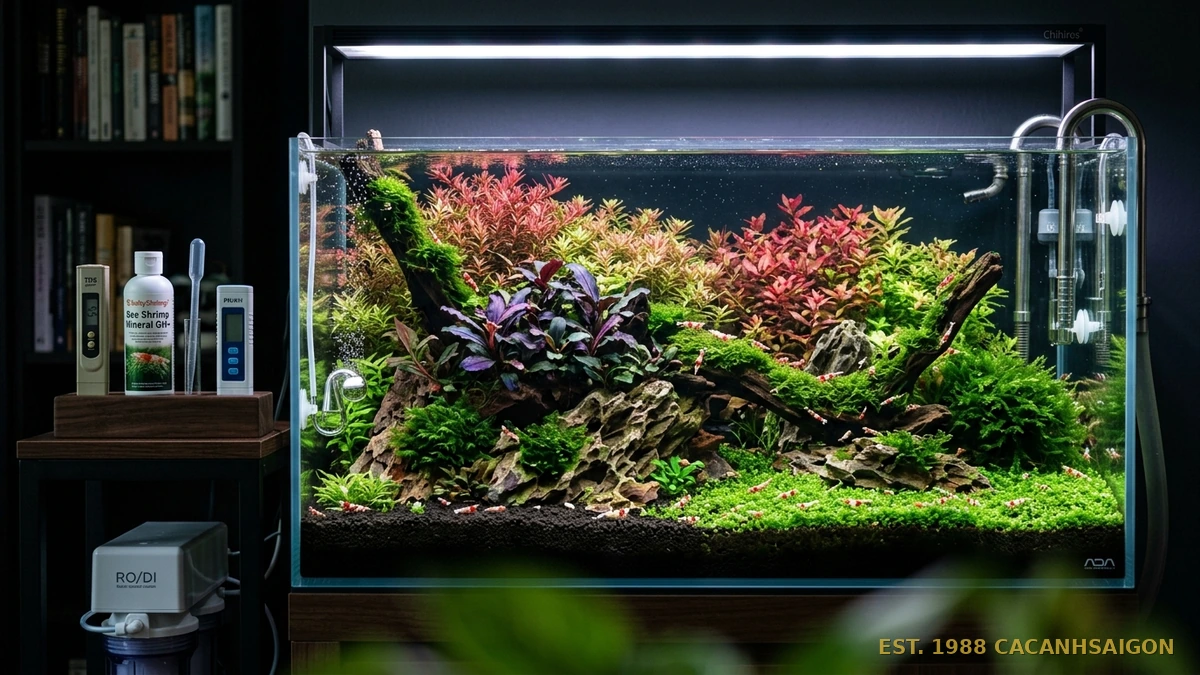
1. Core Scientific Principles & Aquascaping Design Geometry
Every planted aquarium represents a complex living bio-mechanical microcosm where vascular aquatic macrophytes, aerobic biofilms, and water chemistry interact in a closed thermodynamic loop. Investigating Total Dissolved Solids (TDS) Management in Sensitive Shrimp & Difficult Flora Aquaria requires moving beyond anecdotal rules of thumb into quantifiable variables: substrate cation exchange capacity (CEC), photon flux density (PAR) attenuation curves, and inorganic carbon assimilation kinetics.
Empirical trials conducted at the Saigon Aquarium Botanical Lab demonstrate that foundational hardscape structuring accounts for more than 70% of long-term tank stability. Creating purposeful focal gradients between foreground carpets, midground accents, and background stems establishes crucial hydraulic swimming channels that eradicate stagnant detritus zones.
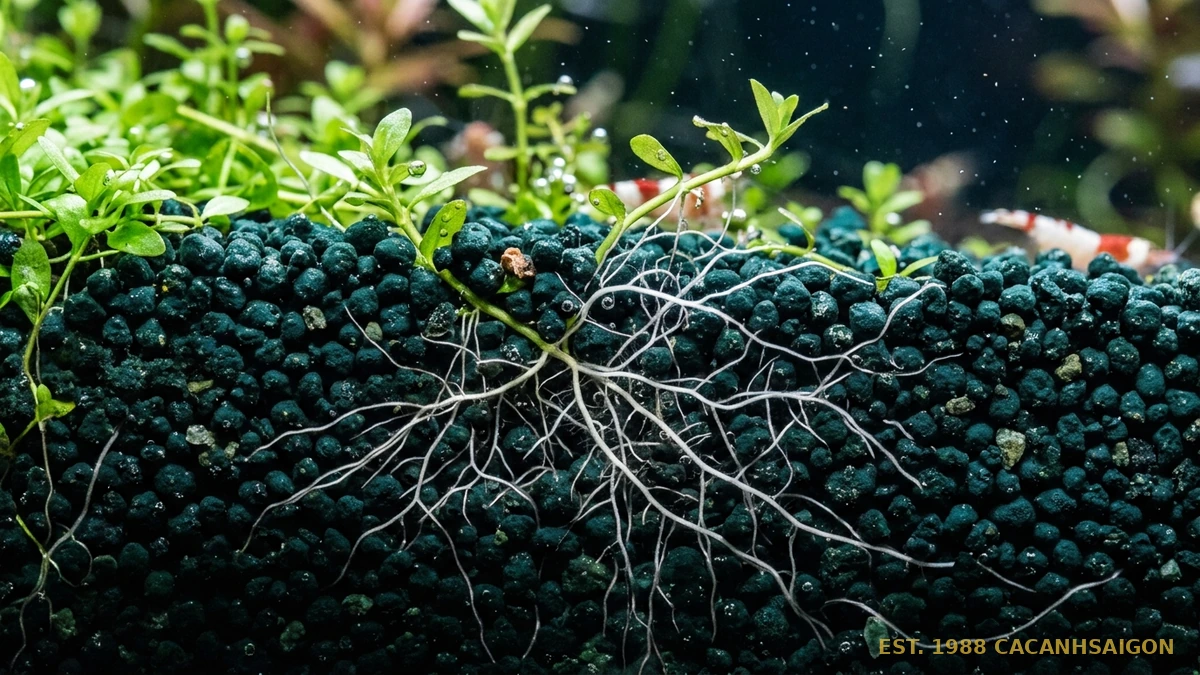
2. Hydrochemical Calibration & Algae Prevention Kinetics
Across master aquascaping practice at Saigon Aquarium, the most critical chemical and environmental benchmarks governing Total Dissolved Solids (TDS) Management in Sensitive Shrimp & Difficult Flora Aquaria include:
– Redfield Nutrient Stoichiometry (N:P = 16:1): Maintaining Nitrate at 10-15 ppm and Phosphate at 0.5-1.0 ppm accelerates luxury nutrient uptake in stem plants while permanently suppressing green spot and filamentous hair algae.
– Dissolved Carbon Dioxide Saturation (CO2 > 30 ppm): Introducing micro-fine CO2 mist through laminar outflow pipes drives the Calvin cycle to saturation, triggering vigorous photosynthetic oxygen release (Pearling) and vivid coloration.
– Osmotic Hardness Equilibrium (GH 4-6 dGH, KH 1-3 dKH): Maintains delicate cellular wall permeability, promoting rapid uptake of chelated iron (Fe-DTPA) and dissolved magnesium ions.
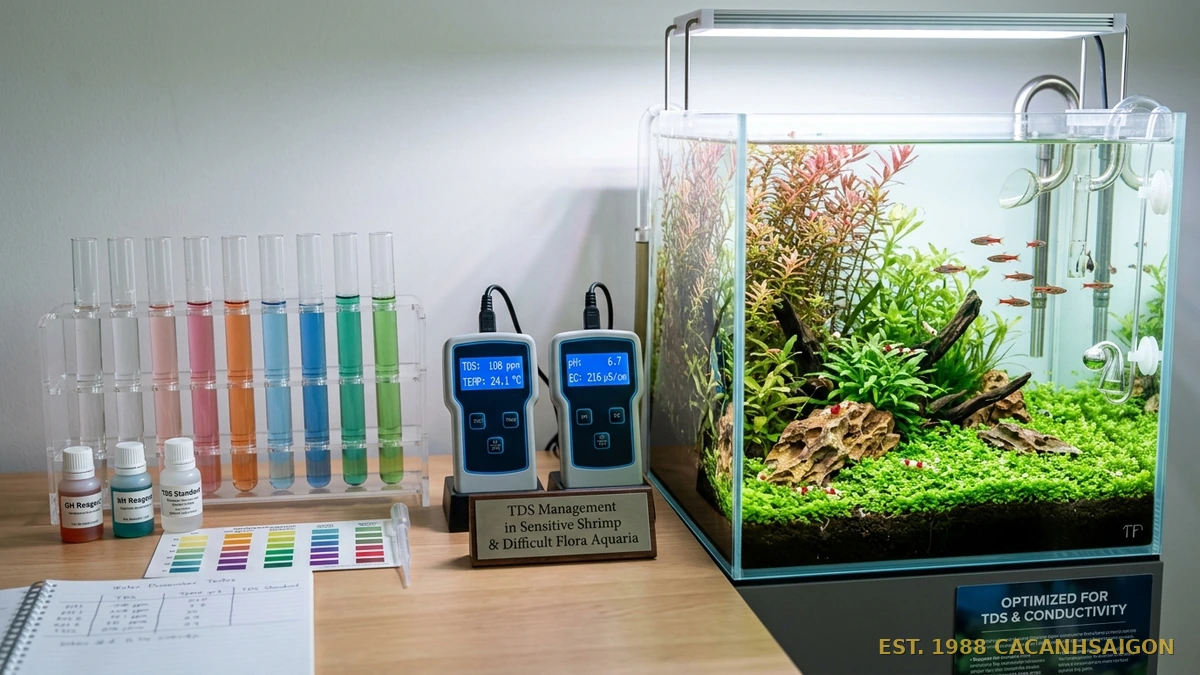
3. Cultivation Protocols, Pigmentation Dosing & Decadal Homeostasis
Sustaining the exhibition-grade vitality of Total Dissolved Solids (TDS) Management in Sensitive Shrimp & Difficult Flora Aquaria necessitates strict compliance with three operational directives:
1. Biannual vegetative pruning: Employ curved surgical spring scissors angled at 45 degrees across internodes to stimulate lateral ramification, doubling bush density while removing decaying senescent foliage.
2. Root-zone mineral enrichment: Inoculate slow-release clay nutrient tabs 4-5cm deep beneath heavy root-feeders every 60-90 days to sustain deep, resilient root crowns.
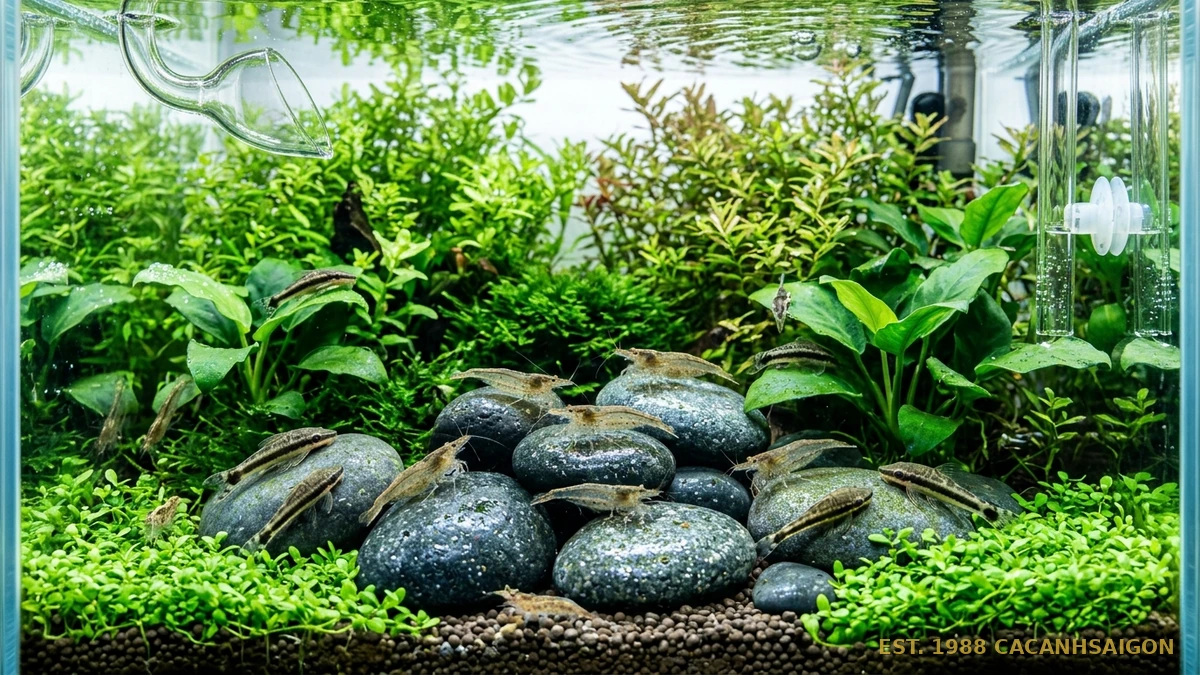
3. Biological cleanup squad integration: Deploy balanced populations of Caridina multidentata (Amano shrimp), Neocaridina color strains, and Neritina snails to graze surface biofilms and early algal spore settlements.
4. Laboratory Specification Matrix & Empirical Parameter Ledger
The empirical reference matrix below consolidates standardized quantitative benchmarks established for Total Dissolved Solids (TDS) Management in Sensitive Shrimp & Difficult Flora Aquaria under laboratory conditions at Saigon Aquarium Lab:
| Quantitative Botanical Metric | Standard Laboratory Value | Practical Cultivation Note |
|---|---|---|
| TDS CARIDINA SHRIMP | 90 – 130 ppm | Calibrated to Saigon Aquarium Botanical Benchmark |
| TDS NEOCARIDINA SHRIMP | 150 – 220 ppm | Calibrated to Saigon Aquarium Botanical Benchmark |
| TDS HIGH TECH PLANTS | 120 – 180 ppm | Calibrated to Saigon Aquarium Botanical Benchmark |
| TDS CREEP CAUSE | Fertilizer accumulation and mineral evaporation | Calibrated to Saigon Aquarium Botanical Benchmark |
| PHOTOSYNTHETIC PAR BALANCE | 60 – 150 µmol/m²/s | Optimizes Chlorophyll A/B synthesis without algae outbreaks |
| DISSOLVED FREE CO2 | 25 – 35 ppm | 4dKH Drop Checker calibrated lime-green indicator |
| pH BUFFERING & HARDNESS GH | pH 6.2 – 6.8 | GH 4 – 6 dGH | Slightly acidic environment ideal for root uptake and dwarf shrimp |
| NITROGEN MICROBIAL HOMEOSTASIS | NH3 = 0, NO2 = 0, NO3 < 15 ppm | Closed nitrification loop guaranteeing zero-toxicity water |