Net Water Volume Calculation & Hydraulic Filter Sizing
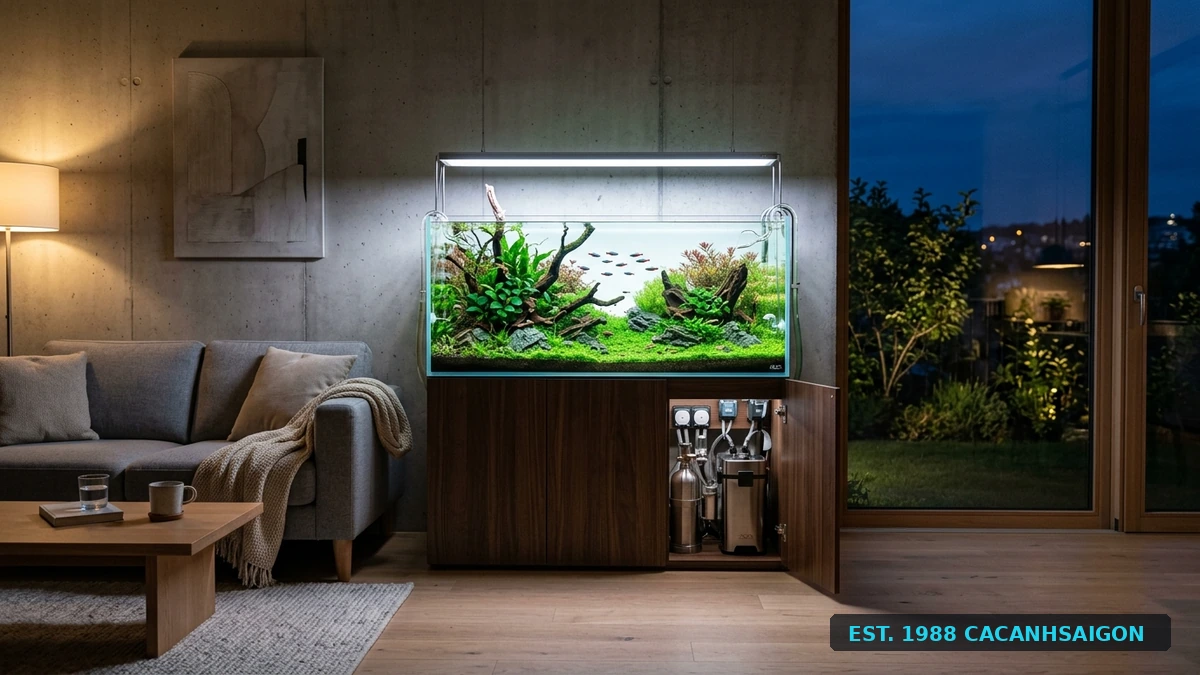
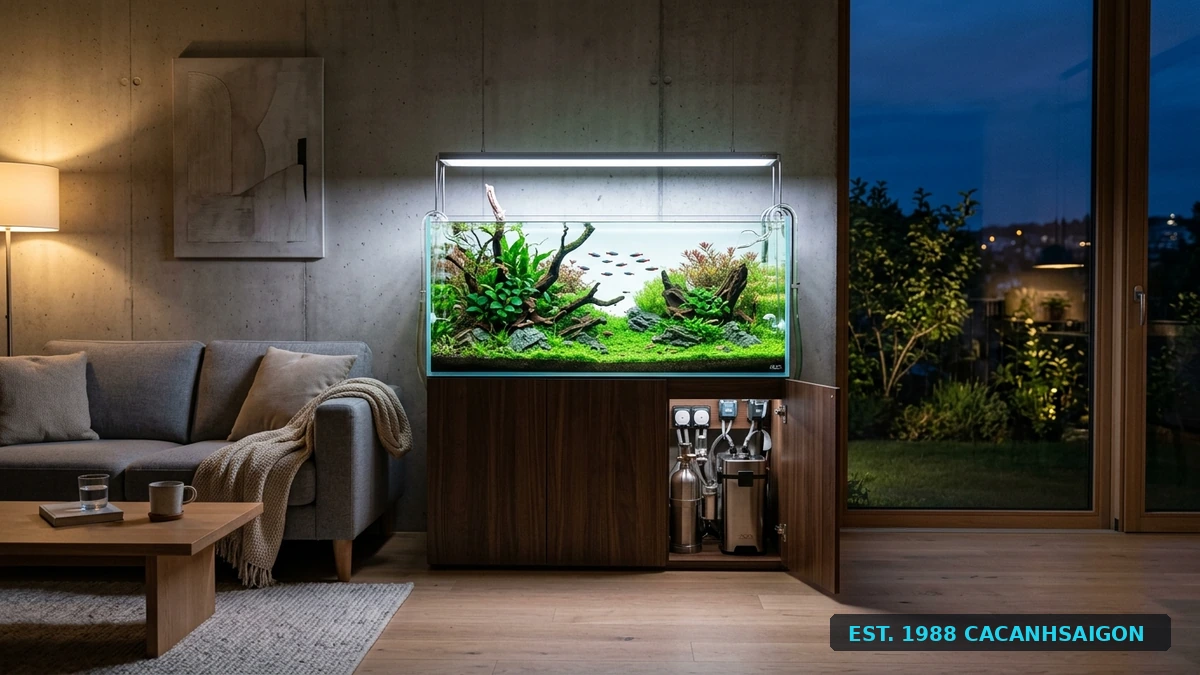
Filtration sizing errors are responsible for over 80% of persistent water cloudiness, ammonia spikes, and chronic black brush algae outbreaks in captive aquariums. The pump manufacturer rating on the box is measured at zero head height with empty media canisters; real-world flow rates invariably drop by 35% to 50%. Here is our hydraulic engineering guide from Saigon Aquarium Lab.
1. Calculating Net Water Volume: Archimedes Substrate Displacement
To find true water volume: multiply length x width x height (in cm) divided by 1000 to get gross volume in liters. Subtract 10% for water line gap, and subtract substrate volume (soil height x length x width / 1000). Dense Seiryu hardscapes displace another 8% to 15% of total volume.
2. The 5x – 8x Hourly Turnover Rule
For planted aquariums, total water volume must circulate through the bio-media beds 5 to 8 times every hour. For a net 80-liter tank, you require actual throughput of 400 to 640 L/h. Due to canister media friction and pipe resistance, select a pump rated for at least 800 to 1000 L/h.
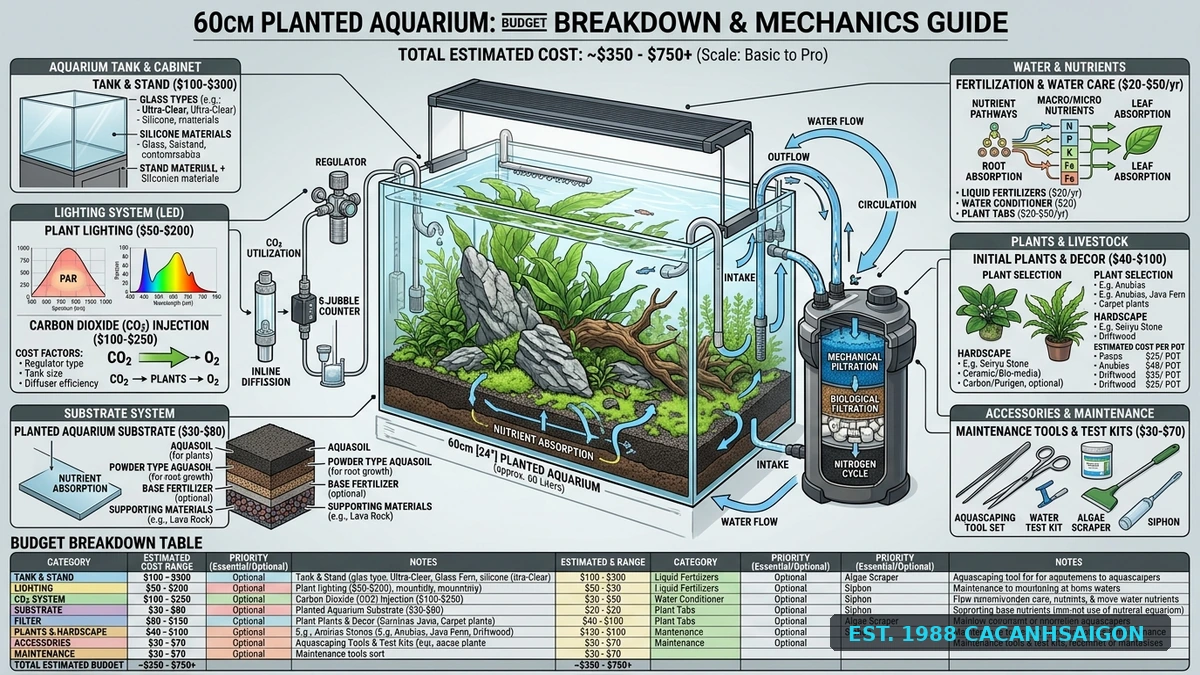
3. Hydraulic Media Layering: Mechanical to Biological Sequence
Always route inflow through coarse mechanical foam (20–30 PPI) first to intercept macro-detritus. The intermediate chamber holds porous bio-rings with high specific surface area. The final outflow stage utilizes fine polyester floss or chemical purifiers like Seachem Purigen.
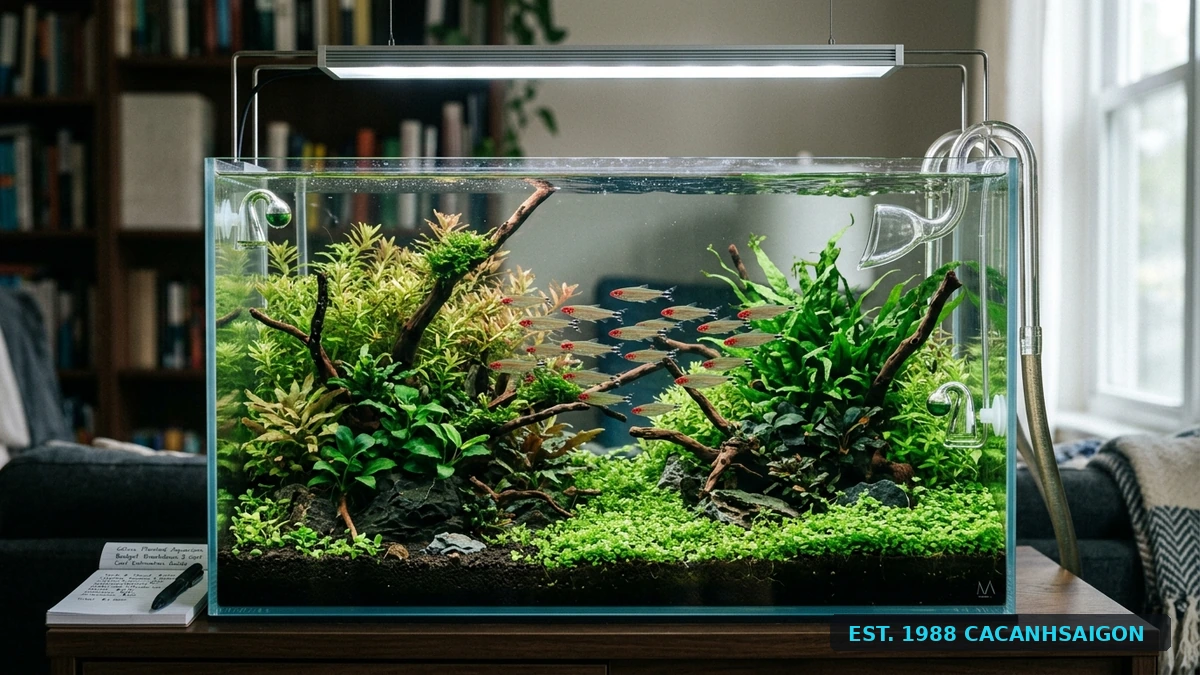
4. Hydraulic Pump Sizing Reference Matrix
| Tank Dimensions | Gross Vol. | Net Water Vol. | Min. Nominal Flow | Ideal Bio-Media Volume |
|---|---|---|---|---|
| 45 x 30 x 30 cm | 40 Liters | ~30 Liters | 350 – 500 L/h | 2.0 – 2.5 Liters |
| 60 x 40 x 40 cm | 96 Liters | ~75 Liters | 800 – 1000 L/h | 4.5 – 6.0 Liters |
| 90 x 45 x 45 cm | 182 Liters | ~145 Liters | 1200 – 1600 L/h | 8.0 – 10.0 Liters |
| 120 x 50 x 50 cm | 300 Liters | ~240 Liters | 2000 – 2800 L/h | 14.0 – 18.0 Liters |